
Starlight, Telescopes, and Problem Solving #054
From high desert telescopes to real-world challenges—what I learned about asking better questions

“Wait… Did They Discover Dark Matter Here?”
I said that out loud.
Standing next to a telescope at Kitt Peak Observatory, I was geeking out.
“With this telescope… is where they made measurements that led to the discovery of Dark Matter!”
Dark matter? Really? … but let’s rewind.
The Question
It all started with a simple question: “What are you doing this weekend?”
I had plans to drive to Phoenix to visit my uncles and grandma. But Friday evening was still open. Some coworkers were heading to the golf course. Others booked a spa. Then someone mentioned an observatory, and another immediately said, “I’m in.”
That sparked my curiosity. I only knew about the one in Flagstaff. A quick search (a.k.a. research) led me to Kitt Peak Observatory, just a one-hour drive from our hotel in Tucson. Jackpot.
From Oil Spills to Optical Lenses
That week I’d been part of a Technical Challenge, helping evaluate how different teams tackled ten tricky tasks. Real-world, messy problems with no instructions and no access to Google or GPT…just schematics, toolkits, and whatever brains and experience they brought with them.
The challenges were carefully designed by seasoned trainers…people who’ve seen hundreds of breakdowns and know where most mistakes come from. And watching 18 participants try to reason their way through these scenarios sparked something in me.
It tied right into what we’ve been exploring in this series:
How might we prepare graduates with skills that complement—not compete with—what AI can already do better, faster, and cheaper?
Last week, we talked about Adaptability (read it here).
This week, we’re looking at Problem Solving…not because McKinsey defines it in one line, but because it’s the focus of an entire course they offer online for free. Here’s how they frame it:
“Problem solving is a structured approach to identify root causes and recommend practical solutions.”
And that’s exactly what I witnessed in the challenge.
By the way, let’s pause here and define “problem.”
A problem is simply a situation that presents uncertainty, friction, or a gap between what is and what could be. It’s a question waiting for a good answer.
Somewhere along the line, we gave problems a bad reputation. But they’re just friction points…portals into improvement. When you shift your mindset, and treat problems as puzzles instead of burdens, the entire emotional weight of the situation changes.
Desert Roads and Stargazing
Back to the story. We ended up being four curious minds: Omaira, Nick, his wife Tami, and me. I topped up the rental’s gas tank, said “Lobby at 4,” and off we went. A straight, scenic drive through the Sonoran desert led us to a closed gate…
DO NOT ENTER
But underneath: Only pre-booked guests can pass. That was us. We began the winding 12-mile climb up to 7,000 feet. As the desert faded behind, temperatures dropped to a perfect 22°C. No power lines. No light posts. No distractions.
At the summit: Kitt Peak National Observatory.
After check-in (and a sandwich), I ran into one of the guides. He asked if I was the driver of the gray Jeep Compass. “Yep,” I said.
“Mind parking it in line with the others? I’ll explain why later.”
Inside, our guides—three in total—began the tour. One was a freshly graduated astrophysicist with geeky charm I immediately vibed with.
We learned about the mountain’s sacred significance to local Indigenous groups. A mural near the first telescope beautifully honored that connection, made from the same mirror material used in early observatory work.
Then, sunset.
150,000-Year-Old Light
Looking west, the guide asked, “How long does it take light from the sun to reach us?”
“Eight minutes,” I said reflexively.
“Correct. But do you know how long it takes for a photon to travel from the sun’s core to its surface?”
“A lot more! … about 200,000 years,” I answered.
“Right again. The light you’re seeing now started its journey long before humans even built pyramids.”
He then blew our minds with this:
“The sun you’re watching? It already set two minutes ago. What you’re seeing is light refracted by the atmosphere. It’s a mirage.”
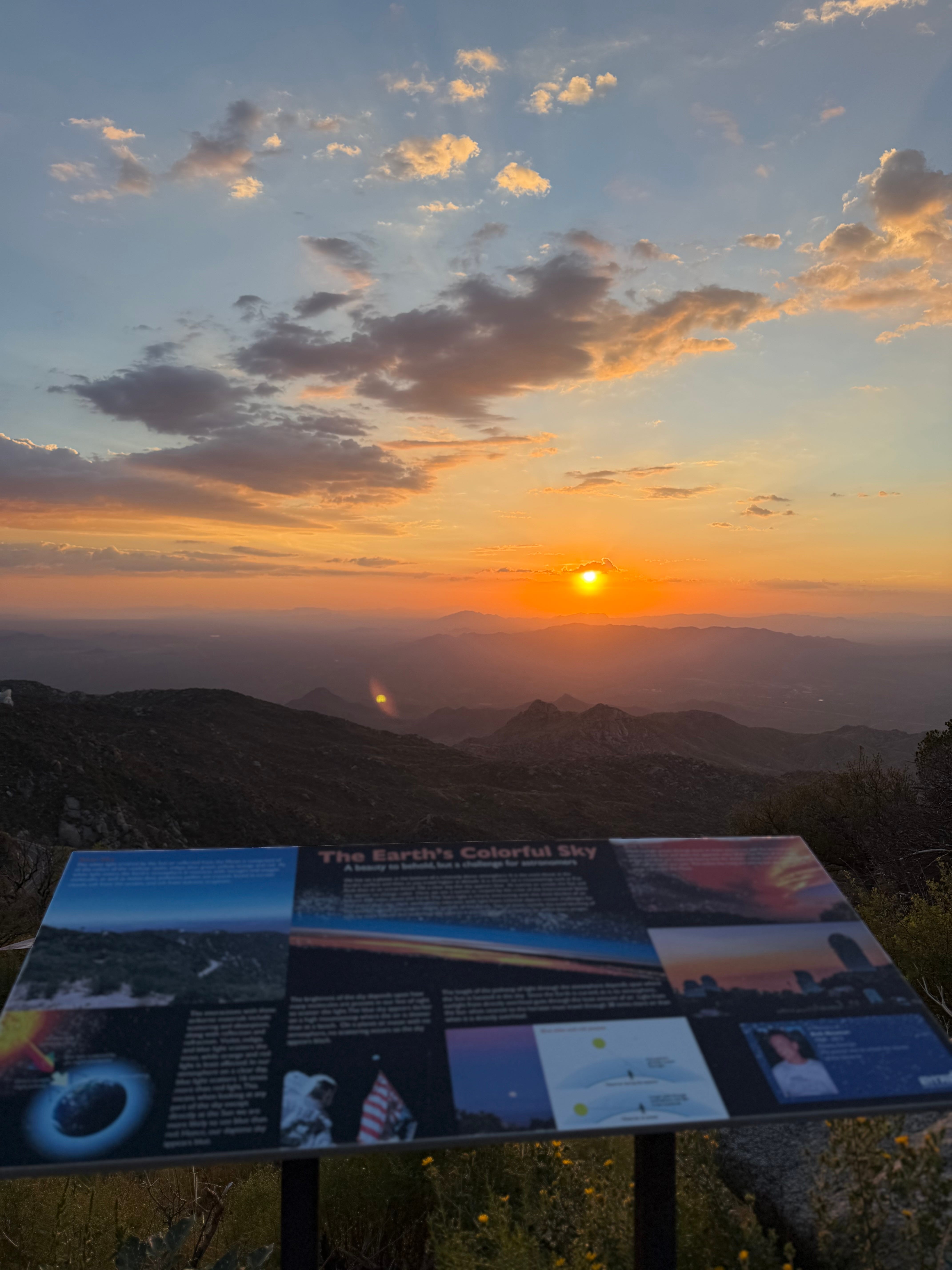
We discussed mirages, the moon, and illusions of scale. Then, why Arizona’s famously clear skies (only 60 cloudy days a year) made it the perfect location for the observatory.
Down the Mountain and Into the Sun
He pointed to a unique telescope—shaped like a giant number 7 lying down.
“That’s the McMath-Pierce Solar Telescope. And we’re going inside.”
We split into two groups: one hiked to the Solar Telescope, the other was driven to the Exoplanet Telescope.
The Solar Telescope is a marvel: sunlight reflects through a mirror into a 500-foot shaft, then bounces back up onto a table. That table, our guide told us, was where Apollo astronauts studied the moon’s surface to plan their landing. Goosebumps.
In another room, we saw a sphe
rical hologram projector showing planets, orbits, and atmospheric data. It felt like stepping into the Rebel base war room.
Meet Vera Rubin (and Her Quiet Revolution)
Then came the part that tied it all together.
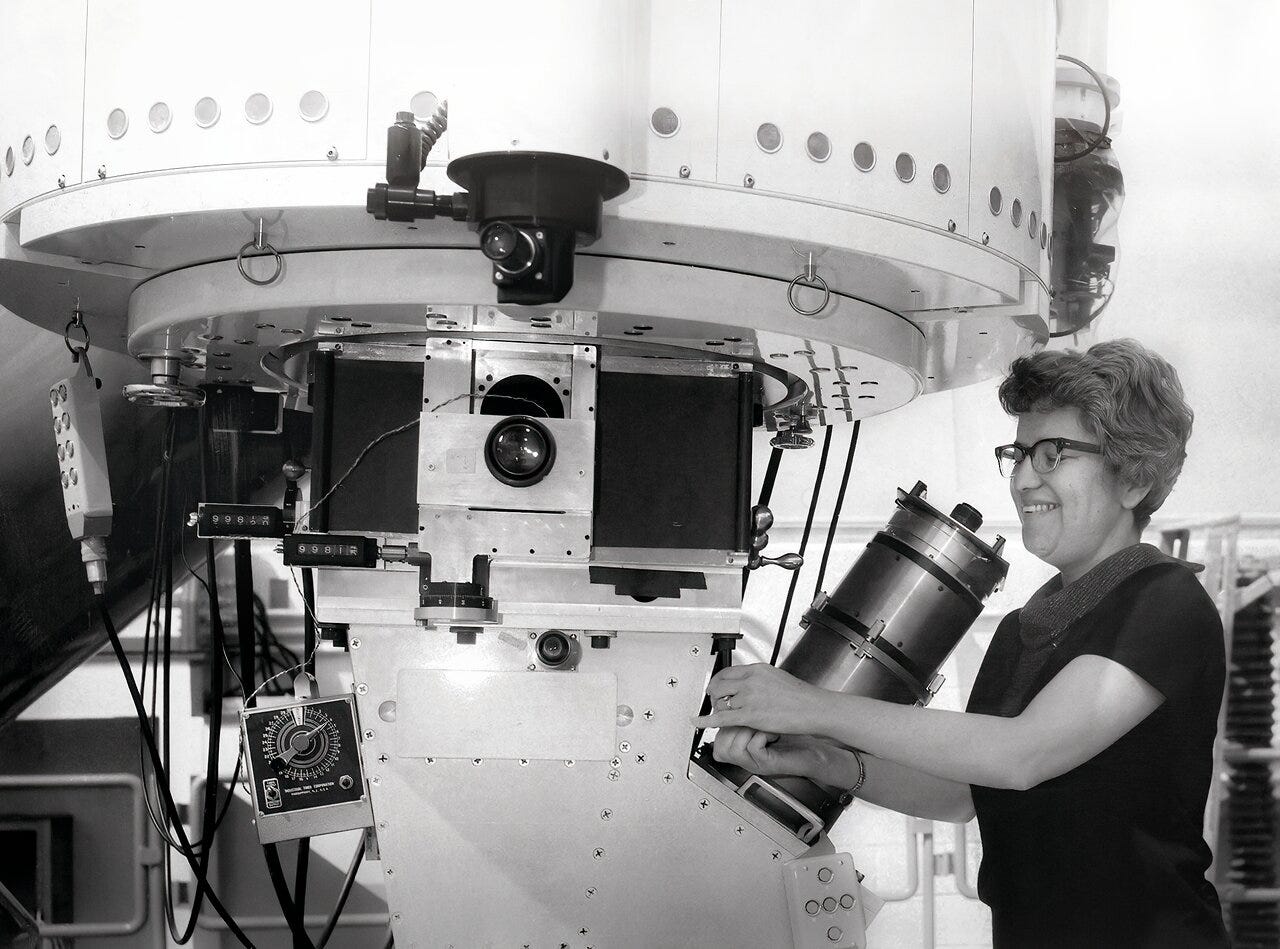
“You see that telescope over there? That’s where astronomers like Vera Rubin gathered some of the evidence that led to the discovery of dark matter.”
In the 1970s, Vera Rubin and Kent Ford used spectrographs…some tested at Kitt Peak…to analyze how stars moved within spiral galaxies. They noticed the outer stars rotated way too fast for the visible mass to hold them in.
But Rubin’s breakthrough didn’t come easy. For years, she was one of the only women in her field. She was often excluded from observatories, denied credit, and told—more than once—that women didn’t belong in astronomy. She pursued her PhD while raising four children and constantly had to prove herself in rooms that weren’t ready for her. Yet she persisted. Not with anger or fanfare, but with rigorous science and unshakable clarity. Her work reshaped our understanding of the universe—and made room for generations of women in science to follow.
That meant… there had to be more mass.
Not stars. Not planets. Something else. Something invisible.
Dark matter.
Light Years Away
Later, we reached the exoplanet telescope. It observes distant worlds by measuring how their host star’s light dims as the planet passes in front. That tiny dip in brightness gets analyzed with supercomputers to determine composition.
We even got to look through a powerful telescope at M13, the Hercules Cluster—a globular cluster (not a constellation) located 22,000–25,000 light-years away.
And yes, I saw it. I saw ancient light. The past. With my own eyes.
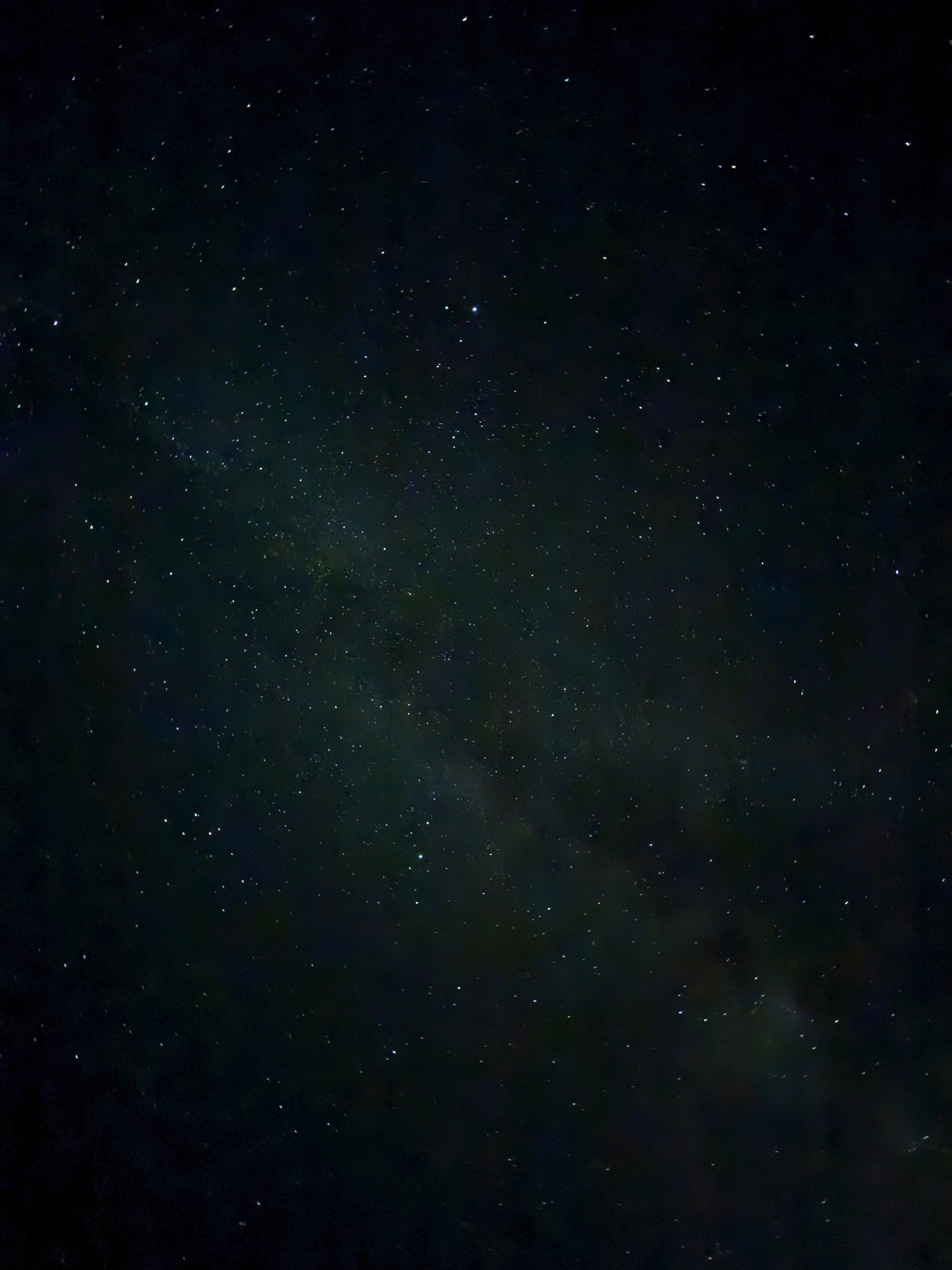
Before that, out in the open with just binoculars and red flashlights, I counted three shooting stars in under ten minutes. I even managed to capture the Milky Way with my phone…no fancy lens, just the clearest sky I’ve ever seen. Imagine what those big telescopes can do.
The Ride Down
Midnight approached. No streetlights. No room for error.
We lined up the cars. At a signal, headlights turned on. A slow convoy descended the mountain. Down below, the orange glow of Tucson sparkled like another galaxy.
Problem solving isn’t just about tightening bolts or calculating rocket thrust. It’s about asking better questions. Reframing unknowns. Working through fog to find clarity.
Whether you’re under a machine or under the stars, it’s the same drive: understand the unknown, and give it a name.
And that’s what I saw… both in the challenge and in the sky.
Want to keep exploring timeless human skills?
Subscribe to the SiMPL newsletter and join us next week as we unpack curiosity.